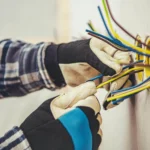
Plastic-sheathed Romex (Type NM-B Nonmetallic-Sheathed Cable) is prohibited in the vast majority of New York City buildings under NYC Electrical Code amendments to NEC Article 334. To prevent toxic smoke propagation in high-density multi-family dwellings, stop rodent chew-through inside pre-war plaster chases, and shield conductors from drywall screws, NYC mandates metallic wiring methods: Type AC (Armored BX), Type MC (Metal-Clad) cable, or steel EMT conduit. Any unpermitted Romex discovered during a co-op board review or DOB inspection triggers immediate violation notices requiring professional Electrical Wiring NYC remediation.
Contractor Used Romex in Your NYC Apartment Renovation?
No, standard PVC-jacketed Romex cannot be used in Manhattan co-ops, condominiums, commercial spaces, mixed-use properties, or high-rise residential buildings. Under NYC Electrical Code amendments to NEC Section 334.10 and Section 334.12, nonmetallic-sheathed cable is strictly banned in commercial occupancies, fireproof or semi-fireproof masonry buildings, and residential structures exceeding strict height and construction-class thresholds. In densely packed NYC party-wall rowhouses and high-rises, PVC jacketing releases corrosive hydrogen chloride gas when exposed to fire and offers zero mechanical crush protection against masonry settling or rodents. Consequently, virtually every apartment alteration and New Construction Wiring NYC project specifies interlocked steel or aluminum armored cable or rigid metal raceways.
Failing Inspection Over BX Cable Ground Wire Problems?
While contractors casually call all spiral metal cable BX, modern Type MC (NEC Article 330) and Type AC (NEC Article 320) have completely different grounding architectures. Legacy pre-war BX cable relied solely on its spiral steel armor as the fault-return path, which develops high impedance as joints loosen or rust over decades. Modern Type AC cable adds a thin 16-AWG bare aluminum or copper bonding strip in continuous contact with the inner armor, allowing the outer sheath itself to act as an equipment ground. By contrast, Type MC cable contains a full-sized, green-insulated copper Equipment Grounding Conductor (EGC) inside the armor (such as 12/2 MC with a dedicated #12 AWG copper ground), because the outer spiral jacket of standard Type MC is not listed as a fault-current path on its own.
Anti-Short Red Head Bushings and NEC 314.16 Box Fill
Under NEC 320.40, every cut end of Type AC cable must be fitted with an insulating anti-short bushing (commonly called a Red Head) between the sharp steel armor edge and the THHN conductors, and professional NYC electricians install them on Type MC terminations as well. Additionally, every conductor and internal EGC entering a 4-inch square or 1900 steel junction box must be sized under NEC Table 314.16(B) (2.25 cubic inches per #12 AWG wire) to prevent pinched insulation and thermal build-up.
Exposed Wiring in a Manhattan Basement or Storefront?
Although flexible Type MC copper cable is ideal for fishing inside closed brownstone partitions and metal-stud apartment walls, Electrical Metallic Tubing (EMT conduit under NEC Article 358) is mandatory for exposed basement runs subject to physical damage, commercial mechanical rooms, subpanel feeder risers, and poured concrete deck slabs. Whether you need a Manhattan licensed electrician to strip illegal Romex out of a co-op renovation or want to review our 2026 NYC house and apartment rewiring cost guide, call Energize NYC at (646) 718-5996 or book a code-compliant wiring estimate online.
Still Unsure Which Cable Your NYC Job Needs?
- Is Romex (NM-B) ever legal to install in a New York City apartment or commercial space?
- What is the main difference between Type AC (BX) cable and Type MC cable?
- What happens if a NYC DOB inspector or co-op board finds Romex installed by a general contractor?
Is Romex (NM-B) ever legal to install in a New York City apartment or commercial space?
No. NYC Electrical Code amendments to NEC Article 334 prohibit Nonmetallic-Sheathed Cable (Romex) in all commercial buildings, co-ops, condominiums, and multi-story residential buildings above strict story/construction limits. Almost all NYC renovations require Type MC/AC armored cable or metal conduit.
What is the main difference between Type AC (BX) cable and Type MC cable?
Type AC (Armored Cable, NEC Article 320) uses its interlocked metal armor combined with an internal bonding strip as the equipment grounding path and requires anti-short bushings at every termination. Type MC (Metal-Clad Cable, NEC Article 330) pulls a dedicated, full-sized green insulated copper ground wire inside the armor.
What happens if a NYC DOB inspector or co-op board finds Romex installed by a general contractor?
A NYC DOB electrical inspector will fail the rough-in or final inspection and issue an electrical code violation, while co-op alteration managers will halt construction until a licensed NYC electrician strips out the NM-B plastic cable and replaces it with listed Type MC cable or EMT conduit.
Energize NYC
155 Wooster St, New York, NY 10012
(646) 718-5996
www.energizenyc.com
Need an emergency electrician in NYC? Call (646) 718-5996, available 24/7.